


The following is a talk recorded for “A New Hope for Global Human Rights,” hosted by Responsible for Equality and Liberty (R.E.A.L.) on December 10th, 2025, at the National Press Club in Washington, D.C. This talk is also available on YouTube in video format.
Timestamps:
00:00 Introduction
01:48 Understanding what “othering” means
04:43 Finding another way to see to create a new relational reality
05:22 How the language of healthcare and disease drives exclusion
09:44 How this shows up in counter-extremism efforts
12:10 Finding a better way to see, a better way to aim at the problem
13:30 Looking at the environment that a wound is embedded in
15:15 The wound or disease isn’t bound to a landscape so much as it’s trapped in a TIMESCAPE
18:56 How this all applies to us today
21:00 Why it seems like human rights are a fantasy
22:39 An invitation to see the wound with wonder
What is Othering?
Pushing an individual beyond the pale, and pushing them so beyond the pale that not only do you not see them as human anymore, but you see them as open game, as open season on them. You see them as available targets for whatever aggression or frustration you might have. That other person becomes a target. These are very ancient patterns. We’ve seen them from time immemorial between one clan and another clan, one god and another god. It’s not just that they’re “other” and separated or segregated from society, but that separation becomes weaponized, and the aim becomes the other. Given this crisis, the invitation then becomes, can we find another way to create a new relational reality?
The Language of Disease and Sanitization
When we take real human issues in our culture, and we label them as a disease, we’ve already “othered” them, as something that needs to be eradicated. The language around that is that it needs to be sanitized. When we’re looking to sanitize, we’re looking to ‘cleanse’ a people or a group. We’re seeing that play out in global wars in ethnic cleansing, attempts to cleanse a people of their beliefs through advocacy religiously. There are attempts to sanitize a population to remove people who don’t look like what is believed to be the collective. All of this is done under the guise of a value, but this practice not only otherizes but also divorces us from ourselves. It reinforces a myth that we have to live pristinely, and that becomes policy that treats people who look different as some kind of invasive species.
The reason that kind of rhetoric is unfortunately effective is because who doesn’t want to eradicate a disease? When you take what is well-meaning in healthcare and apply it to people, it becomes a weapon. It becomes something used to inflict tremendous pain on a population, employing very simplistic language.
The Need for Another Way to See
When I worked in counter-extremism, I noticed there’d be a hyper fixation on the disease or what was wrong. Rather than understanding where people were coming from, well-meaning people would stare at the problem; they would fixate on it instead of seeing it as a whole. The problem tends to be stared at, which only amplifies it further.
Why does this happen? There’s a pattern of monetizing a problem for content or exploiting it for an agenda. But we rarely look at a problem with wonder and curiosity.
When I suggest we need to “aim better,” it’s not about aiming a weapon; it’s about our focus, our vision. Not aiming at others as targets, but aiming our focus on the wound with curiosity. Therein lies a critical distinction. When we keep looking at our environment, our culture, our news events, our patterns, as something to be squashed, then that becomes the only language we know. And that is a behavior pattern that is not that different from the disease itself. A disease looks to overtake, to overpower, to conquer. And when we take that same approach toward a problem, we become another kind of disease. So you don’t have a clash of civilizations, you have a clash between disease and disease.
If we change our perspective and see the wound as something to be understood, we can deepen ourselves; we can deepen our own lens.
Looking at the Environment a Wound is Embedded in
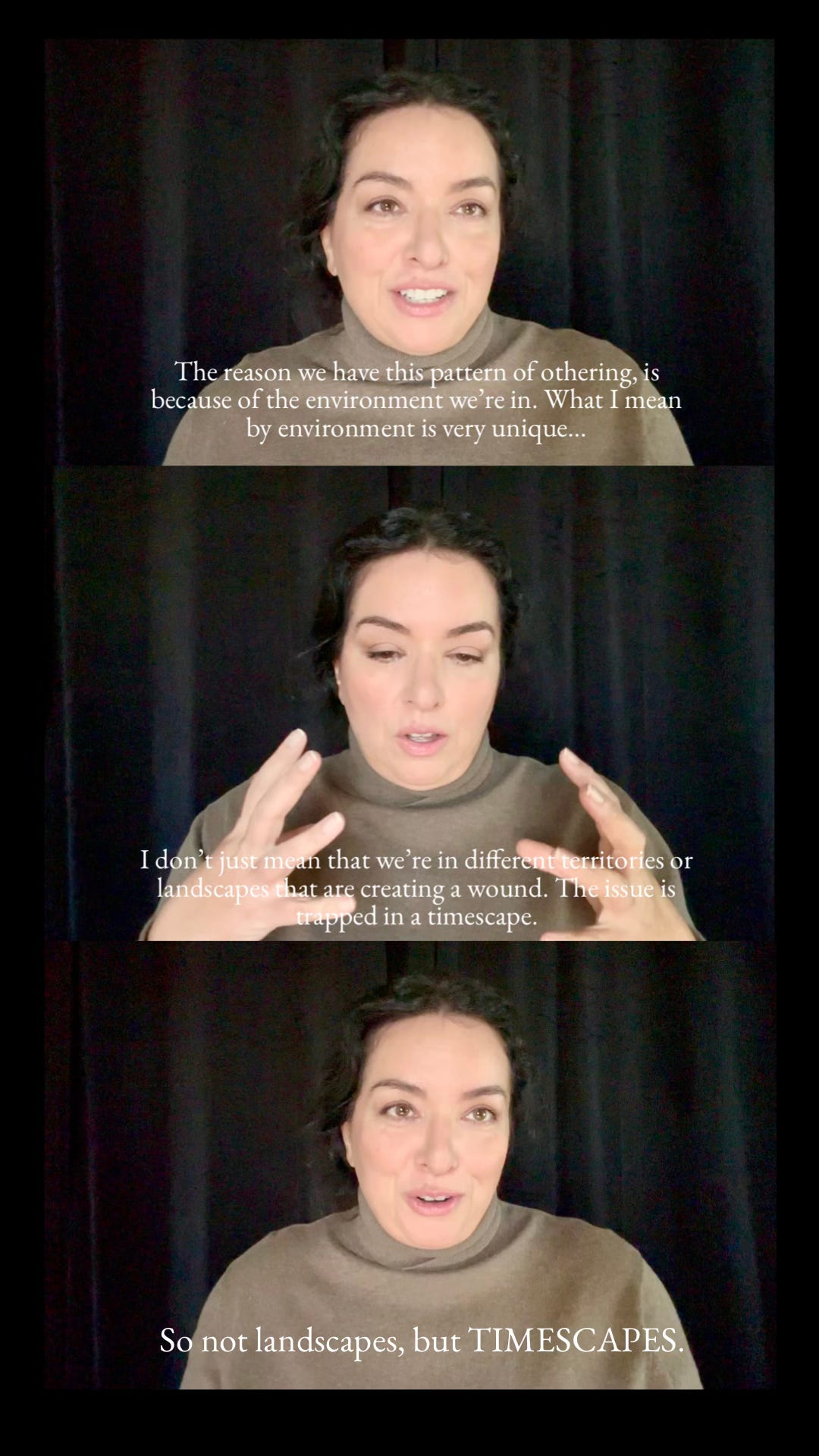
The reason we have this pattern of othering, the reason we have this wound essentially is because of the environment. What I mean by that is something very unique. I don’t just mean that we’re in different territories or landscapes that are creating that wound. The issue is that the wound is trapped in a timescape. So not landscapes, but timescapes. Let’s take a closer look at that…


