

As a woman, I never particularly cared about gender roles in the home until I started noticing a couple of things. First, despite my son being surrounded by strong archetypes of mother, maiden, crone, he was yearning for a stable, engaged, father figure. I’m divorced, and while his dad is in the picture, clocking in once a week for a few hours is a very different thing than being a father. That’s not to insult his father; these are just the facts.
A sound father figure isn’t something I thought about my son lacking until he expressed a biological need to be around other men around the age of 7. I notice the same patterns in the sons of friends who are also divorced. While each child is unique, each child did suffer in some way from not having a man around.
It’s no secret that many boys today aren’t getting enough time around men. Instead they have celebrity substitutes like Jordan B. Peterson, Ben Shapiro, and BAP. Although their messages have drawn an audience of young men, it’s no substitute for their real fathers.
Around this time, I also took my experience in Islamist extremism into extremism across other ideologies. There is one common denominator between young men who joined an extremist ideology: there was a conflict in the home centered on the absence of a strong, grounded male presence. Typically, either the father contributed to an environment of trauma or the father was missing, which is its own trauma.
As a mother to a young boy, I don’t have the luxury of ignoring these facts if I hope to raise a young man who can survive this world. If I’m exploring the cornerstones of manhood, I’m not alone; a lot of men and women out there have the same question.
After the Parkland High School shooting, Fox News published an article on “The desperate cry of America’s boys” that touched on a Twitter thread by comedian Michael Ian Black, who wrote: “Men don’t have the language to understand masculinity as anything other than some version of caveman because no language exists…[we] don’t know how to be our whole selves. A lot of us (me included) either shut off or experience deep shame or rage. Or all three.”
My neighboring city of Los Angeles experienced its last mass shooting on a high school campus. In November of 2019, a 16-year-old opened fire at Saugus High School, killing two classmates before turning the gun on himself. As detectives raked through a motive, they missed the most obvious factor: a broken father figure.
The shooter’s father died in December 2017, and with two prior DUI records it seemed his father also struggled with alcohol. Reports also show that the young man relied on his girlfriend for emotional support. He opened fire, ultimately killing himself on his 16th birthday.
If we’re trying to understand what is going on with our boys, we don’t need to fight amongst ourselves, battling between grievance tweets on thoughts and prayers, pointing fingers on the constitutional right to carry arms, or nose-diving into political rage. That doesn’t do anything except drive a culture of acceleration that extremists thrive on. Instead we need to focus on the anthropological clues.
The Los Angeles shooter’s example shows a broken father figure. Robert Moore, author of “King Warrior Magician Lover: Rediscovering the Archetypes of the Mature Masculine,” would point to what he calls the shadow figure that surfaces when any one of these four integral components of manhood are broken or misunderstood (let alone all four). In the language of popular culture, this would be the Upside Down of manhood.
No one showed the Los Angeles shooter how to be a man. No one taught him how to stand in his strength, or how to have a relationship that didn’t burden a woman emotionally. Historically, civilizations would have clear, definitive rites of passage for boys to enter manhood, but we have none. Boys are left to wander, and some get into big trouble.
The scenario keeps changing but the formula is the same: fatherlessness and, as Black shares, a culture that dismisses men’s value.
If we can’t come up with a reasonable, achievable track that gives young men status, emotional security, a path to a secure job, and a stable loving relationship, more and more young men are going to be drawn into ideologies that are misogynistic, homophobic, and seek to turn the clock back on all the gains of the last 50 years. Extremists are telling young men, “The system isn’t working for you and doesn’t care if you live or die. But we care, join us.”
Now there is another form of ideological extremism being forced onto our boys: gender fluidity. We just passed International Men’s Day on November 19, which would have been a wonderful opportunity to discuss manhood. Instead the ACLU celebrated International Men’s Day with a campaign on how “men who get their periods are men.”
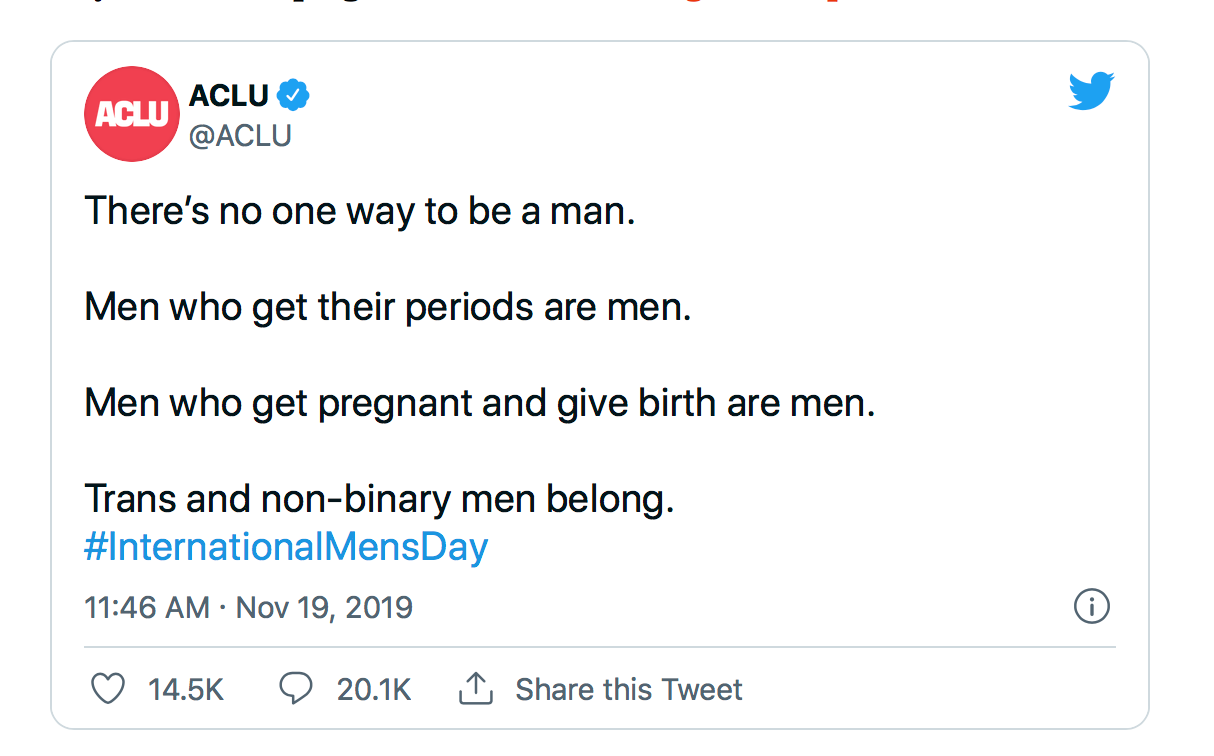
Newsweek ran an article about International Men’s Day on mental health, but completely ignored the opportunity to a have a real conversation. Instead they curated conversations about discrimination related to race and sexual identity, self-care, depression, and how it’s socially acceptable to wear pink. That was it.
It’s got to be hard being a man today, let alone trying to navigate growing up into one. Your entire identity is systematically being scrubbed from existence. You’re repeatedly told you’re not good enough, punished for not conforming, and gaslighted into believing you are a distortion of your true nature. The lack of sound male figures in a young man’s life is part of the social breakdown across the board, from gravitating to extreme ideologies to participating in acts of violence.