

The first time I saw a representation of myself as a woman, it wasn’t some brand sticking a big girl in a leotard and making her look like she could cut you in a street fight. It was the Venus of Willendorf, the figure of a Paleolithic goddess 28,000 to 25,000 years ago. I’ve long said that I have the body of a goddess, a Paleolithic goddess. Some days, that still feels true. You might think that sounds lovely — but no. Let me show you. This is what a Paleolithic goddess looks like:
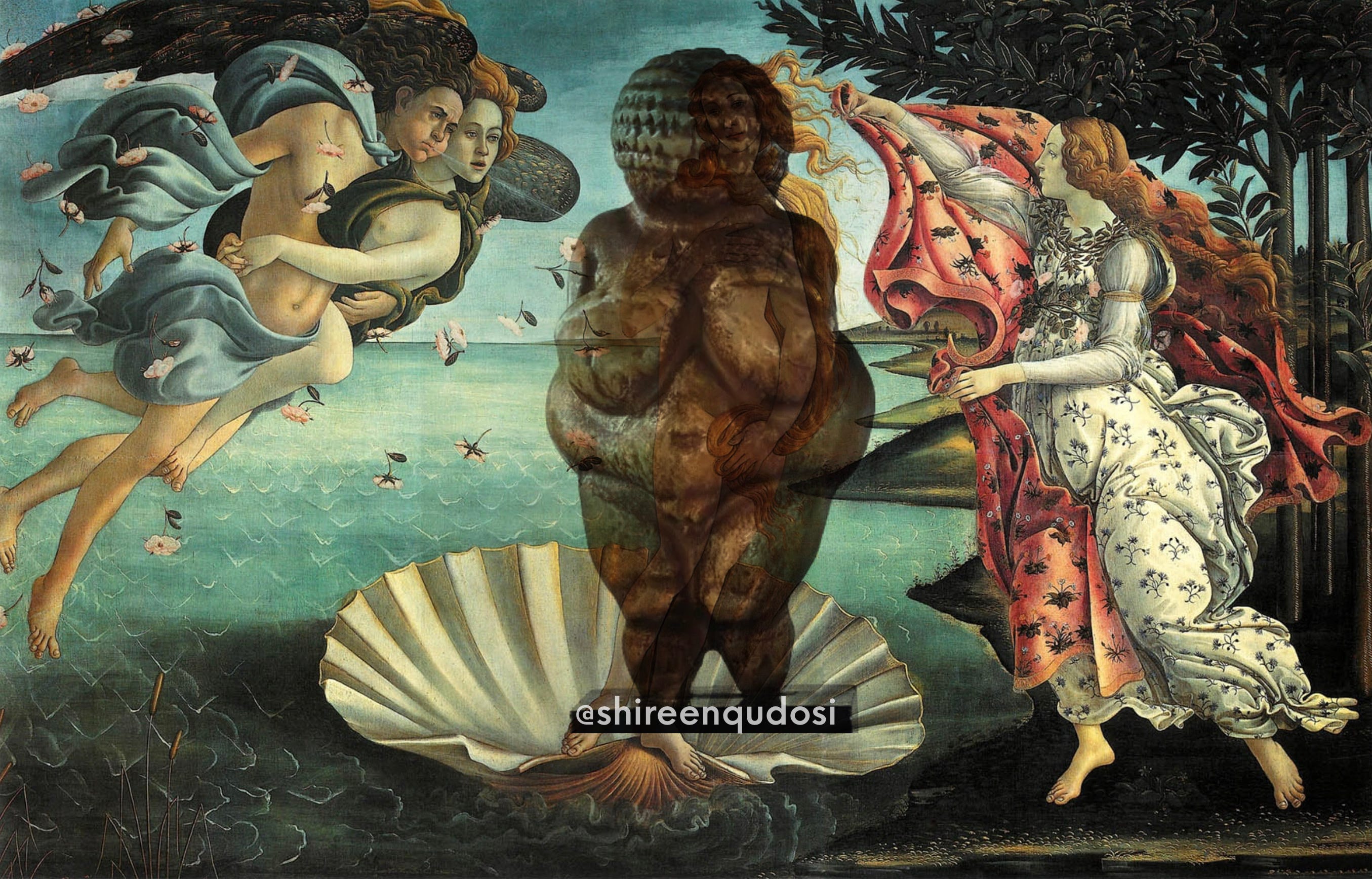
Now that I’ve shared my secret with you, you might understand when I say this: Please stop celebrating obesity through “fat-positive” campaigns. I put in a lot of work to lose enough excess weight to go down four sizes and gain a lot of strength and muscle. Those of us who have had to work really hard to change forms have some opinions that aren’t colored by brand endorsements or sponsors.
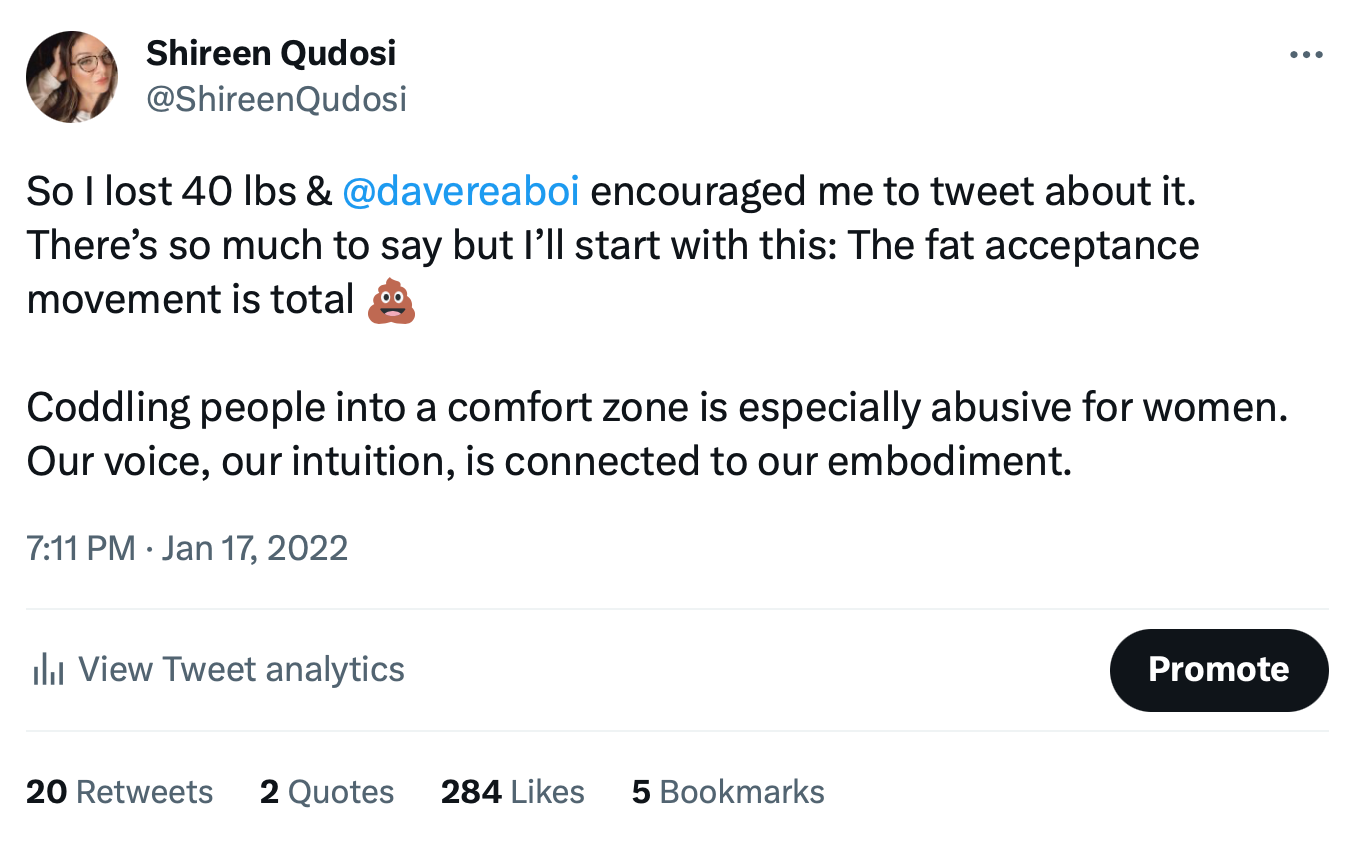
As a woman who still puts in work to stay healthy in a plus-size frame, desensitizing women's bodies by glorifying largeness isn't a movement about what feels good to women. As someone who has cruised all around the scale from thick, to way too thin, to curvy, to plus size, to super fat, to plus size, to curvy on a good day with no bloat — I have something to say:
Guys, being fat doesn’t feel good. It just doesn’t — or at least it doesn’t feel as good as being in better shape does feel. If you’re a non-fat person saying this, you don’t know what it feels like to be fat. If you’re a fat person, you’re either lying to yourself — or you don’t know how much better you deserve to feel.
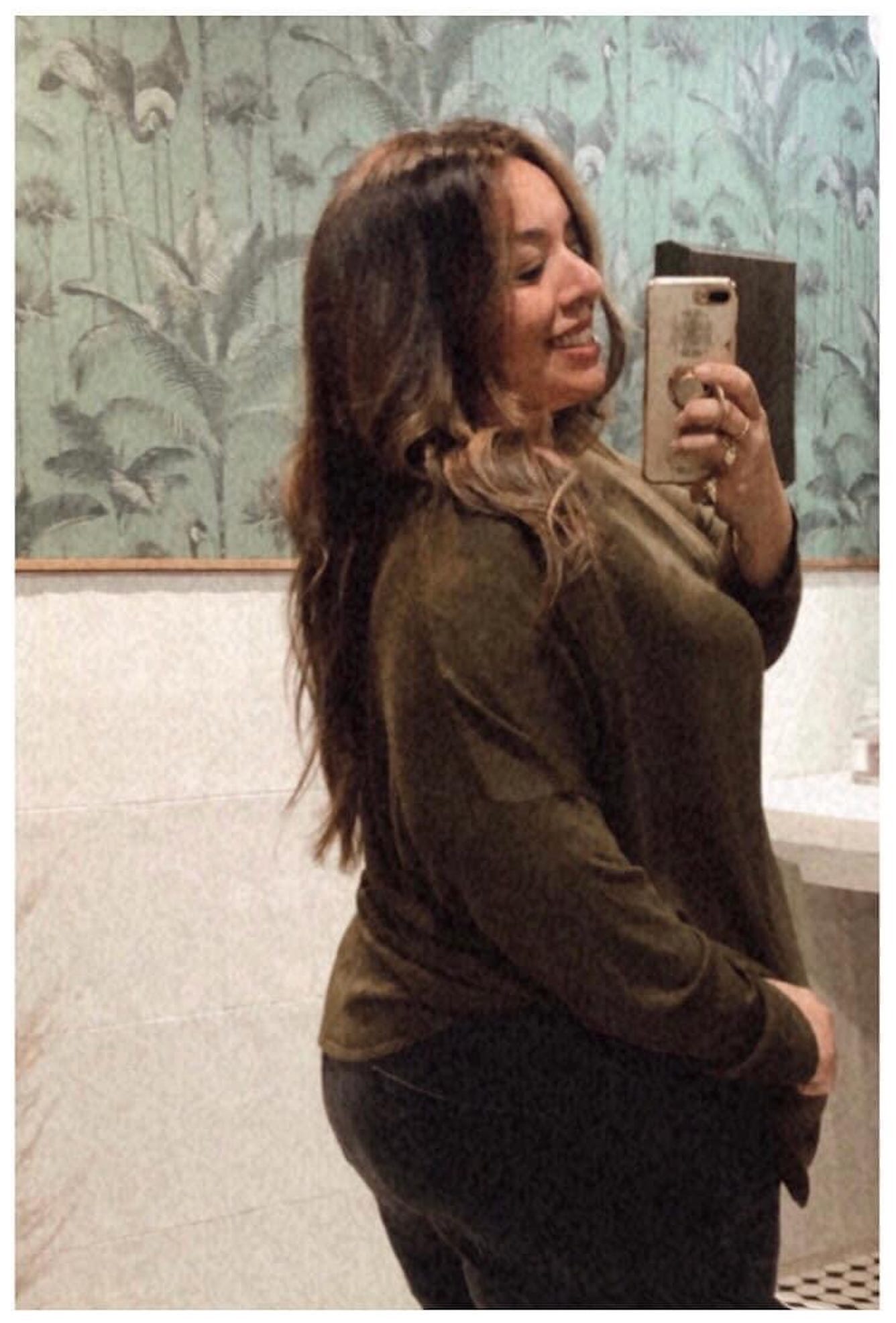
A conversation on weight needs to be a conversation on form and function, NOT beauty. If you care about people, you’ll care about having a conversation that helps them. We should be talking about shape in relation to form and function (in which being heavier is just one part of a broader dialogue). I’m not talking about a person’s beauty or worth. I’m talking about whether we can move, and what movement offers us physically, emotionally, and spiritually — especially as women. In fact, being in our bodies and connected to them is so foundational to what it means to experience life as a woman, that the phrase I use to talk about this is women’s rites. I want us to expand the container of belonging to older traditions where women embraced being women. As much as women’s rights have done to advance the condition of women in the world, rights without rites are one step forward 5 steps backward.
The Feminine Restores Women’s Rites
Women deserve to feel — and not just occupy — our bodies. That means acknowledging our gender.
We cry colonization, but don’t see what else colonizes. An idea can colonize a person just as much as a foreign power can colonize a land. Colonization is a mindset long before it is a physical overtaking of one land through the ideology of a foreign entity. It often is a mindset still after the physical occupation has ended.
“That women exist doesn’t mean that anything else needs to exist less — but we will not give up our ground so that another idea can come in and destroy us.”
— Shireen Qudosi
In other words, the culture we’re in encourages women to abandon our gender or be willing to negate and compromise our existential reality as women. That a woman’s form exists doesn’t mean that anything else needs to exist less — but we will not give up our ground so that another idea can come in and destroy us.
This is especially personal to me as a South Asian and a Muslim woman who worked really hard across 22 years to find myself. Going against the grain of cultures that happily feeds you ways to destroy yourself, I had to move beyond all the ideas that invaded ground and for a time killed off the wilderness of my being. I fought to see myself behind the fog of regressive culture and ideologies that piggy-back on faith, tradition, and culture.
That we have a new culture doesn’t make it a better culture. I’m reminded of “Moondust” — the season three episode in Netflix’s series The Crown. Rightly called one of the best explorations of faith ever seen on TV, “Moondust” spotlights Prince Phillip as rocks between the traditions of faith that explore interior frontiers, and the progress of science that has its eyes set on exterior frontiers. Without giving away the plot, the episode is a gentle portrait that we shouldn’t forget our foundations while ascending into tomorrow.
Our foundations.
Our foundations go beyond the idea of fixed timelines. Who I am as a woman, for example, is much older than the advent of Islam. For women to root into the foundations that honor the landscape of a woman’s heart, we have to further back and deeper within.
Ancient cultures all over the world honored women and saw our bodies as sacred. Women were honored for the gift of our intuition, the fluidity of our ways, our ability to feel through our bodies (embodiment), especially when women held leadership roles like priestesses, shamans, midwives, healers, or served as an elder in her crone years. These were and are still sacred gifts. But you can’t feel into your body — and thus tap into your feminine gifts, especially as a seer, unless you are embodied.
Every woman — any woman — has experienced her intuition. Her body’s ‘spider sense’ that tells her something is off. That is a form of embodiment, of the body speak to us. Yet, most of us (myself included for so many years) dismiss it so we don’t rock the boat of anyone else’s feelings. We’re now celebrating as progress the idea that we should be so disconnected from our bodies, further severing our relationship with our deeper feminine aspects.
A woman’s innate gifts course through the body. The gifts of intuition, the ability to move through archetypes, myth, spirit, Jungian shadows, dreams, and so much more, are all rooted in connection to our bodies as women. We’re meant to be in conversation with our body’s wisdom.
Over time, just like colonization, we’ve forgotten our mother tongue — the language of our bodies. We traded in what is precious about us as women in exchange for cheap trinkets.
It unsettles me to see women conditioned to be further and further separated from our identity as women — whether through pronoun erasure, blurring biological differences, to being trained to perform new tricks for old treats. It worries me to see women be conditioned to ignore that we are our strongest when we are in full conversation with our bodies. As women, we deserve to enjoy our gifts and use them for the benefit of the larger community. We deserve rest and beauty, spaciousness to allow for wading in mysteries, navigating labyrinths, dancing in festivals, partaking in real celebrations and rituals, and moving as community.
But we long abandoned so much of that because we wanted to be independent and equally competitive with men in the workplace. While many women are and enjoy that, somewhere we forgot that to be in our sacred feminine as women includes, among other things, beauty. The feminine has always been defined by beauty.
Beauty in the female form, in appearance, in movement.
Beauty in ornaments
Beauty as art.
Beauty as subtlety.
Along with the spaciousness for subtlety to be appreciated.
There is so much to say about beauty here that it’s impossible to speak to it truly — beauty itself is experienced, it’s felt. And the one thing beauty absolutely needs, along with the experienc-er, is spaciousness. Spaciousness in life allows for beauty to be practiced as a womens’ rites. The rites of learning how to practice life as beautiful, instead of life as a bat to beat someone else over the head with because you’re colonized by someone else’s agenda.
“Women’s Rites: the rites of learning how to practice life as beautiful instead of life as a bat to beat someone else over the head with.”
— Shireen Qudosi
To learn to observe the world’s subtlety is also a rite of passage into womanhood in sacred traditions. The rites to embody feminine gifts, and not occupy our body as an agenda. Subtlety requires an amount of distinctly feminine practice, the art of being attuned to something almost ethereal, there and not there, like a silver strand of a spider’s web that the light.
But nothing about the agenda toward fat celebration, or any other grossly in-our-face monolithic movements, holds any of the gently illuminating light of beauty. Now everything is all too much exposed in a light that is glaring 24/7, unflinching, unyielding. It is literally the opposite of what is of the feminine.
It’s the opposite of beauty.
It’s ugly.
It reminds me of that bright blue office light that kills any curiosity by drowning life under its hideous glory — corporate lighting. Movies of Russian interrogation rooms always come to mind with lights like that. It came as little surprise then to learn that Marxism is a willing scythe in killing the oldest religions of the earth that were rooted in worshipping the feminine…because it cannot understand the subtlety of beauty in feminine practices.
“Marxism, [that] on these occasions everything which is not directly productive labor is by mystification, illusion or ‘cunning of reason,’ it must be forcibly pointed out …[only to be turned into a] crude prefigurations of the factory system.”
— The Great Cosmic Mother: Rediscovering the Religion of the Earth
Similarly, the vastness of human belonging is demystified into a pre-packaged product on the assembly line of culture — a cookie cutter of identities where the only acceptable packaging is a homogenous blob. Everything else gets tossed out.
When they take the depth of woman, cut her off from the full experience of being a woman, and put her in the uniform of an identity — they’ve killed the woman, destroyed what makes us wildly beautiful, and pushed her out as another homogenous blob.
