
The Drama Triangle of Distorted Leadership
Many politicians & political influencers draw power from the Drama Triangle, a distortion pattern that constantly suspends the complexity of human experience through a fixed lens of victim or villain.

Absolutely everyone loses in the Drama Triangle because it gives life blood to a system dependent on our mutual annihilation for survival. We have to self-identify as fractals — simple labeled identities of a much larger universe — and see others as the same within the framework of an eternal power dynamic.
In my book, The Song of the Human Heart, I call this system ‘The Distortion’. The Drama Triangle is one understood aspect of it; it is one distortion pattern.
Originally published in The Federalist April 2022
Ilhan Omar took to Twitter on Saturday, April 16th, raising question around a Christian prayer session on a plane 30,000 feet in the air.
Ilhan tweeted:
“I think my family and I should have a prayer session next time I am on a plane. How do you think it will end?”
The tweet seems innocent and indirect, drawing attention to the well-known double standards Muslims have experienced when it comes to our identity as Muslims, versus how Western society responds to more familiar faiths, like Christianity. The most recent sting of this double-standard was experienced during the Ukrainian refugee crisis, which saw Europeans scrub the line of separation between nations and welcome white, blonde-haired and blue-eyed asylum-seekers across their borders, while still often raising the brow of suspicion at their Muslim neighbors.
Growing up as a Muslim, immersed in the Muslim identity, being a daughter of immigrants fleeing war, and being an immigrant myself over and over across three continents — I understand this sting intimately.
Yet, as leaders, we have a duty to be shepherd conversations with radical honesty. This has been the great disappointment in someone like Ilhan Omar. As a child who grew up in a refugee camp, embraced and supported as a refugee in America, and who despite all the obstacles, became a congresswoman — Ilhan Omar undoubtedly has a powerful personal history. She found enough inclusion and support within her state and community to become its champion in the highest halls of power. And yet, rather than rise in power, Ilhan Omar again engaged in what’s called a “drama triangle.” In short — and to put it very bluntly — her leadership style is drama and conflict.
Becky Margiotta, founder of The Billions Institute, an organization that trains foundations and non-profit leaders on how to design and lead large-scale change, recently spoke on the Drama Triangle, which she identified as a fear-induced triangulation between three archetypes: the victim, the villain, and the hero.
Margiotta described the triangulation of these three archetypes as a relationship shift within ourselves and with others, where “We go from our essence state, which is an unperturbed, relaxed, available for connection, available for creativity — into a more narrowed, compressed state, where we really only see our selves and other people as one of three options.” Those states are victim, villain, and hero — often referred to also as either victim, rescuer, or persecutor.
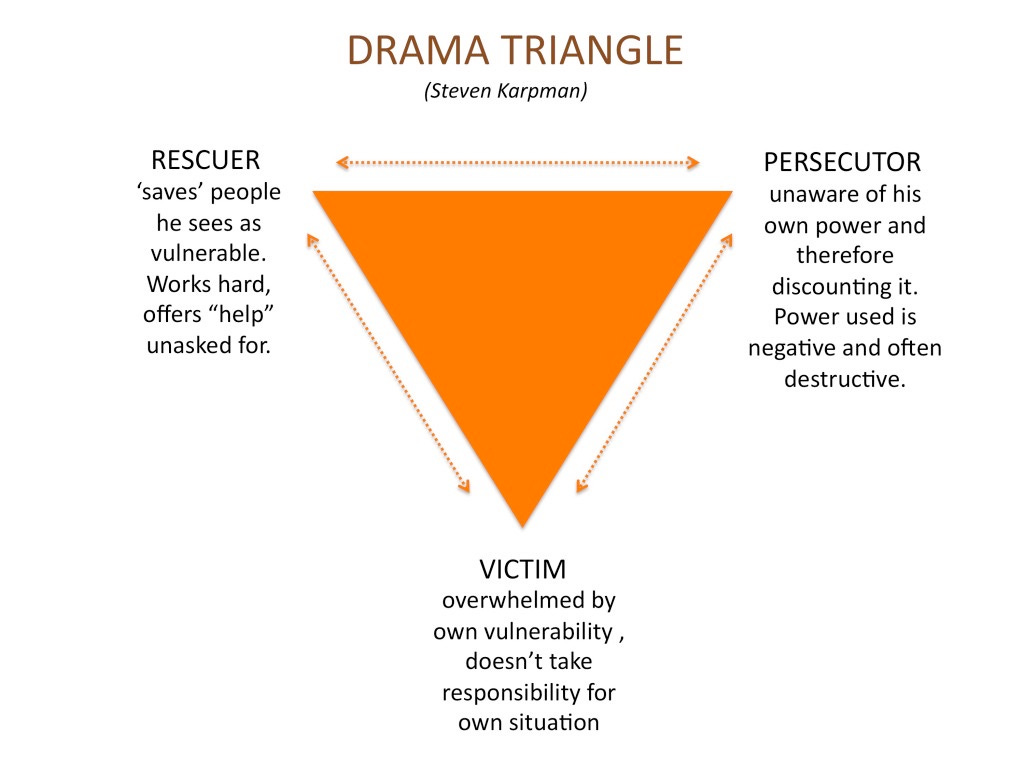
The story of the victim is rooted in the belief that “all of these things are just happening to me,” as Margiotta shared. The villain persecutes, while the hero rescues but doesn’t actually solve or address the bedrock issue that triggers the triangulation cycle.
“These personas go back into older parts in our life, where we couldn’t be, but we had to do to get love and survive,” Margiotta adds.
That reminds me of Omar’s history as a refugee, and that in Ilhan Omar — as I wrote three years ago on this day — we’re looking at someone deeply affected by war and powerlessness, and someone unsteady in wielding power.
The Drama Triangle is a Distortion Pattern
In the Drama Triangle, an individual can also take on a layered identity, which Ilhan Omar does often. Omar paints herself as a victim (as she did again with her tweet) by leading with her identity as a minority Muslim in America. The myth she peddles and relies on to activate The Drama Triangle is that despite her privilege, position, and power, she’s oppressed as a minority in America, which makes America the villain and her the eternal victim despite being one of the most powerful people in the country.
That she as a powerful Black American Muslim woman still totes the victim card at every conceivable opportunity, reinforces the victim-villain myth — because if shecan’t escape it, what chance does any other minority have against such a ‘great’ villain? It echoes the scripts that regimes like Iran share when they call America “The Great Satan.” That’s not to say America has no faults and no stains, but acknowledging the complexity of this nation is very different from claiming it to be the lord of the underworld.
Omar also pivots herself as an outcast here to disrupt systems of oppression, which positions her as the hero. Yet, she also upholds those systems by actively participating in the hero-villain dynamics of the political class that pits the people representing political ideologies against each other.
We saw this most clearly in 2019 when Omar was part of the “squad” of freshman congresswomen including Alexandria-Ocasio Cortez and others. As I told Laura Ingraham in summer of 2019, it’s no different than ‘Crips and Blood’ or ‘us vs. them’ dynamics popularized in gang culture. What we see in her leadership — as well as in the leadership of many of the most popular un/elected voices — is more polarization, more separation, less and less curiosity, compassion, or conscious leadership.
The Drama Triangle traps the symphony of being human, a symphony made up of a chorus of voices and perspectives, including our own rich inner world, and embalms all that life and possibility into the monolith of fixed identity. In someone like Ilhan Omar (and to be fair the vast many politicians, pundits, and influencers who rely on Drama Triangles for relevancy), that fixation looks like a constant see-saw between into interwoven identities — one is the myth of the oppressed and the other is the hero vs the villain. The latter is a physically or psychological violent dance where battles can be won but where no side wins the war. In both versions of her identity, within the Drama Triangle, Ilhan Omar’s identity pivots around the villain: America, Christianity, Conservatives.
Absolutely everyone loses in the Drama Triangle because it gives life blood to a system dependent on our mutual annihilation for survival. We have to self-identify as fractals — simple labeled identities of a much larger universe — and see others as the same within the framework of an eternal power dynamic. In my book, The Song of the Human Heart, I call this system ‘The Distortion’. The Drama Triangle is one understood aspect of it; it is one distortion pattern.
In a distortion pattern, as Margiotta shares, “The full range of possibilities of human expression and human experience kind of go out the window, and the world narrows to just one of three options, which is not super helpful for making the world a better place.”
Indeed, it is not super helpful for improving anything for how polarized and antagonistic our world has gotten, including American cultural dialogue as we work to identify what the next phase of the American experiment could look like.
As a leader in the Muslim Reform space, I began seeing the devastation of drama triangulations in 2019. In 2020, I chose to step away, reflect and reimagine how we can develop a new paradigm. In that time, I founded a non-profit called The Foundation of Human Belonging, which looks at the intersection of faith, identity, and belonging through a broader lens.
The old lens would have attacked Ilhan Omar for the irony of her claim of practicing the Islamic faith, given there’s been no demonstration of her being a practicing Muslim — or it would have looked at the fact that public demonstrations of an Islamic prayer (on a plane no less) have typically ended in someone getting killed. Neither of these maneuvers drive the conversation forward. Neither of these are useful conversations. In a new paradigm of conscious leadership, I ask us to look at how belonging is either nurtured or distorted, to observe the pattern of behavior, identify the pattern, and then dismantle distorted pattern and programming. The Drama Triangulation is a toxic form of engagement, perpetually gridlocking self and others into shallow orientations that can never be more than the dull classification of victim, villain, or hero. The story of who we are has more depth and dimension than we could ever imagine.
The Foundation for Human Belonging
In his last interview with On Being host Krista Tippet, philosopher-poets John O’Donohue said,
“It often seems to me here that a person believes that if they tell you their story, that that’s who they are. And sometimes these stories are constructed of the most banal secondhand psychological and spiritual cliches. And you look at a beautiful face telling you a story that you know doesn’t hold a candle to the life that’s secretly in here.”
At the heart of it, O’Donohue’s quote has been with me long before I knew who we was and long before I heard those words. There’s a universality in his words.
As an immigrant over and over again across three continents, I was shaped by all the people and perspectives I encountered. The experience enriched my life, and deepened my curiosity about what makes us who we are, why we believe what we do. It’s what led me into a 20-year journey to understand Islam, a 4 year journey in understanding extremism, and life-long journey into what I call the cavity of silencethat has me asking myself everyday, “Who are we?”
I wrote as part of the manuscript for my first children’s book recently, The Silver Line Between the Sea and the Sand, where a little boy looks at the world around him and brings those same questions inward to himself, asking of himself,
“I wonder where I came from…and where I’m going…”
These were always the questions in my heart. As I matured, the question became more refined:
“What is the signature of my identity? What is the imprint of our legacies?”
We are people living in ideologies and systems none of us had any say in creating. Yet, everyday in some way or the other we copy and paste the old program into and onto ourselves and others. We ‘rinse and repeat’ the same patterns that brought us to our frustration point, and wonder why the world isn’t becoming a better place.
All the forms of separation between us and others, all the dulled curiosity dead-heading our desire for real intimacy in understanding other people — all these things are at the source of our frustration.
Ilhan Omar’s tweet over the double standard of why Christians on a plane receive one reaction, is an expression of frustration of separation between people. But her own reaction to it, the way she leads and responds to her own inner orientation of the world, is also another form of separation — a micro separation between people by pushing them into the narrow confinement of fixed identities within the Drama Triangle. Her tweets (as many tweets by many politicians) requires a victim and a villain — it is the proverbial good guy/bad guy dynamic that is as old as faith and as destructive as world wars.
Ironically, her ability to understand and have sympathy for the narrative of extremists doesn’t extend of sympathy for the narrative of the complexities we face as Americans who are collectively drifting somewhere between the turning of the page between the old story and the new story of America. As we are still figuring that out, writing that next chapter of what it means to be American, we need leadership that can craft a new story of belonging that isn’t rooted in separation and self-victimization.
Shireen Qudosi is a writer and speaker one faith, identity and belonging. She’s the founder of The Foundation for Human Belonging, a non-profit that looks at the arc of human belonging and helps educate on radicalization and extremism. She’s also the author of The Song of the Human Heart which looks at Islam’s origin story, along with several children’s books, which she’s seeking a publisher for. Follower her on twitter @ShireenQudosi.
Great stuff! Straight to the heart of the matter.