

Summary:
The union of myth and faith through liturgy on full display, our collective identities have long been shaped by group worship.
Dionysus was the Greek god often associated with intensity or hyper-reality. The arc of Dionysus’ identity — particularly the duality of his nature — is a very significant reflection of our times. His fixture on the global stage is a mirror for our collective state of mind. Sure, we’re not worshipping Dionysus as they would in the old days, but attention is attention. When you hyper-focus on something, you give it the creative attention anything needs to come to life. Times that by a world audience and you’ve got the biggest altar of human attention… all eyes on the god of madness.
Dionysus is an invitation to embrace our own multidimensional identity, while in his shadow form, he is a reflection of the challenges we face as a society in finding solid footing in who we are (causing us to slip into states of our own madness).
Orphic mysteries believed Dionysus was ultimately dismembered and devoured by the Titans. The Titans were pre-Olympian gods who ruled the cosmos. They were essentially rogue and uncultured bandits who turned the promise of civilization into a wasteland — not unlike what we see in our society at this hour.
Those of us who are enthralled by the union of myth and faith — filled with wonder and delight — are usually seen as oddities outside our little interest niche. And yet, just a couple of weeks ago the 2024 Olympic Games Opening Ceremony was rich in mythic symbolism for the whole world to see. From beheaded sovereigns looking out of burning towers, to a silver-ribboned ship navigated by a singing woman, to the fact that ceremony broke the perimeter of traditional territory, there was much to feast on for those of us who still read symbols as another language. And of course, there was that controversial feast itself — the amalgamation of the feast of Dionysus (the heathen god of madness) with the iconic Last Supper of Christ. It was liturgy on full display: external public rituals as worship ceremonies versus private worship.
As Peter Harrison summarizes in his book, Some New World: Myths of Supernatural Belief in a Secular Age, our collective identities have long been shaped by group worship. While traditionally that might be mass, baptism, or even Friday mosque prayers, in a secular age liturgy can take on new forms. In a secular society, we still see a signature of liturgy if we look for it. Some argue that could be a concert, music festivals, and other large-scale gatherings that focus group attention. And the Olympics is about as big as it gets, gathering a world of people together with all eyes on the much-anticipated opening ceremony.
If you remember, there was a sort of possessed madness over what many thought was a poor representation of Dionysian Last Supper — complete with drags queens. Though the opening ceremony’s artistic director, Thomas Jolly, shared there was no intention of invoking Christian iconography, the facts be damned. People believed it was Christianity and that was enough to go grab the proverbial pitchforks.
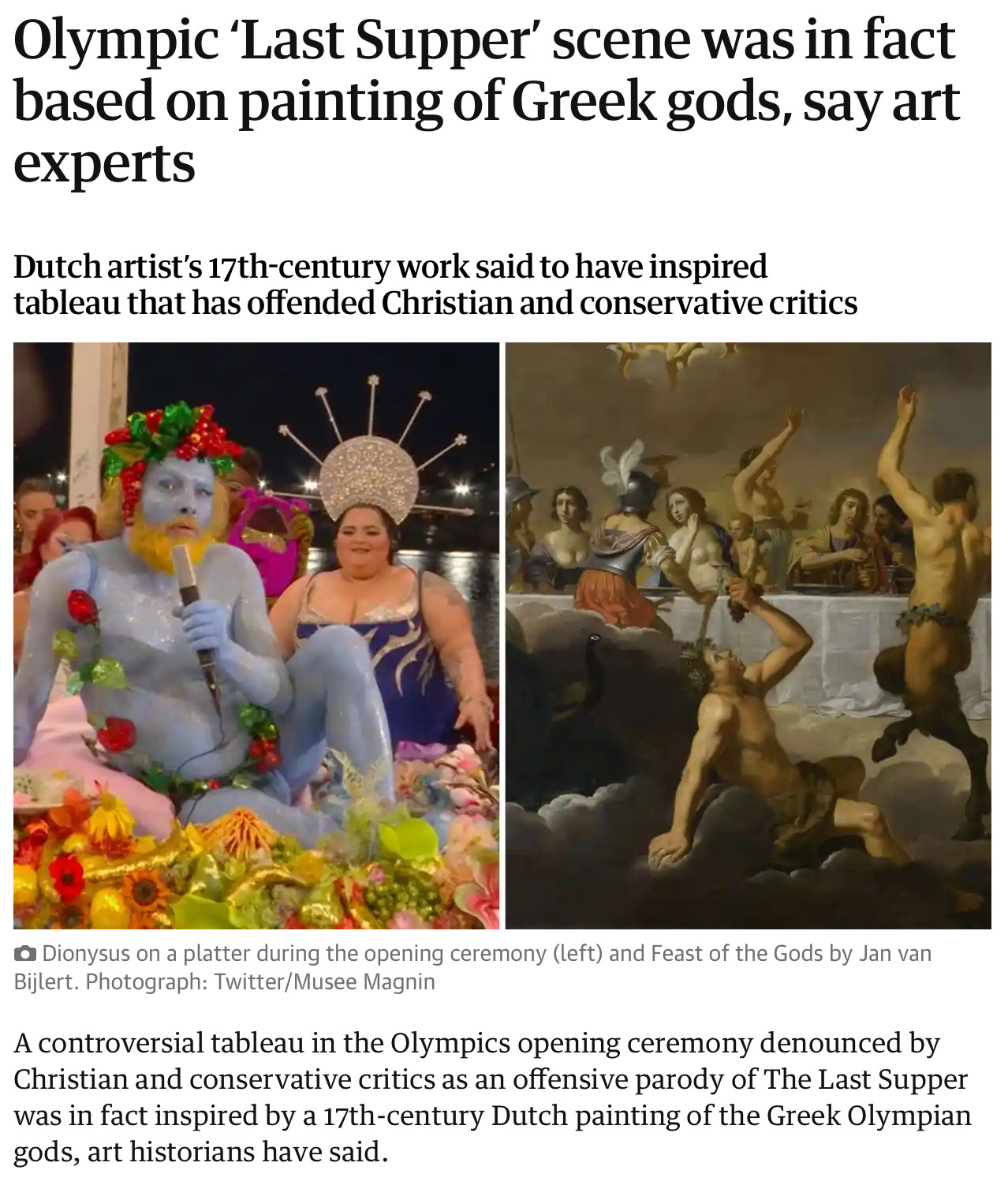
In an article titled “The Lord’s Supper Meets Dionysus In An Unholy Parody,” Religion Unplugged reported:
The Catholic bishops of France admired the "marvelous display of beauty and joy" in the 2024 Olympics opening rites, but also slammed the blending of Christian sacred art, Greek mythology and the sexual revolution.
“This ceremony unfortunately included scenes of mockery and derision of Christianity,” said the bishops. “We are thinking of all the Christians on every continent who have been hurt by the outrageousness and provocation of certain scenes.”
That was soon followed by an appeal to the International Olympic Committee from a global circle of cardinals and bishops protesting "a grotesque and blasphemous depiction of the Last Supper. ... It is hard to understand how the faith of over two billion people can be so casually and intentionally blasphemed.”
But the Vatican remained silent for more than a week while online combat raged between clergy, entertainers, academics, diplomats and armies of social-media warriors.
Finally, the Holy See released a muted statement that it was “saddened” by the ‘offense done to many Christians and believers of other religions. ... In a prestigious event where the whole world comes together around common values, there should be no allusions that ridicule the religious convictions of many people.”
Given the reactionary outrage at this one element out of the whole ceremony, I’d suggest that the public ritual was even more brilliant as far as public rituals go. It wasn’t just about the Dionysian “Last Supper” (as I’ll call it here for brevity's sake); the ritual also included our participation by driving people mad. How very Dionysus.
Dionysus was the Greek god of fertility, and later wine and pleasure — a god often associated with intensity or hyper-reality. Basically, lord of a really good time (unless he was in his shadow side of madness and death). The arc of Dionysus’ identity — particularly the duality of his nature — is a very significant reflection of our times. His fixture on the global stage is a mirror for our collective state of mind. Sure, we’re not worshipping Dionysus as they would in the old days, but attention is attention. When you hyper-focus on something, you give it the creative attention anything needs to come to life. Times that by a world audience and you’ve got the biggest altar of human attention… all eyes on the god of madness.
So what exactly are we being called to and how is it a mirror for the hour?
First, the on-stage drag queens at this feast of Bacchus (as Dionysus was also called) signal the shifting god’s own androgynous identity. A shifting god whose own name and parentage are unfixed is an invitation to both the light and shadow of our collective identity. Not one or the other, but both — the duality within.
Dionysus is an invitation to embrace our own multidimensional identity, while in his shadow form is a reflection of the challenges we face as a society in finding solid footing in who we are (causing us to slip into states of our own madness).
“Dionysus' androgyny is integral to his role as a god of transformation. He transverses gender and sex roles with ease, perhaps because of the myths involving his childhood when Hermes gave infant Dionysus to the Nymphs and he was raised as a girl in order to protect him from Hera's wrath.”
— Dorian Hansen, “An Androgynous God: Beardless Dionysus in Ancient Greek and Roman Art [Susquehanna University]
Second, Orphic mysteries believed Dionysus was ultimately dismembered and devoured by the Titans. The Titans were pre-Olympian gods who ruled the cosmos. They were essentially rogue and uncultured bandits who turned the promise of civilization into a wasteland — not unlike what we see in our society at this hour.
Do we not have our own bandits waging an endless onslaught against Palestine’s civilian population, believing they are privy to every territory endowed to them by cosmic appointment?
Do we not at this moment have a fresh wave of rogue and uncultured gangs of white supremacists waging anti-immigrant riots in the U.K.?
And here in the U.S., are we not devouring each other as we fight over the last scraps of an idea called America?
To devour seems to be the theme of the hour for humanity, with one foot thick in the swamp of broken and outdated ideologies.
And didn’t we see a representation of Dionysus on the table in that opening ceremony, as if to be devoured? A very long story short (which you can read here), it was believed that ultimately the human race was part divine (part Dionysus) and part chaotic evil (part Titans). Are we not mired in the cliche “clash of civilizations” between the divine and the damned? It’s more accurate to point to how the ‘Mad Last Supper’ and our reaction to it was an ode to ceremonial madness complete with group participation.
The oldest story — the story we’re stuck in a loop with — is the story of “good vs evil.” If we could break out of that broken record of “divine vs. damned”, a conflicted duality where someone always loses, then perhaps we could move into a new model of consciousness. Perhaps we could evolve past the linearity of good and evil that has pitted us against each other since time immemorial. Perhaps we could sweep toward identity as an Orphic egg that ushers us toward birthing a boundless, multidimensional reality. If we had space in our culture to remember our rich human heritage, we would understand that a story shapes an identity. And identity shapes behavior.
The behavior we saw after the opening ceremony seemed more in infighting — fighting within ourselves, not seeing who we are, which leads us to project that fight onto the outer world (and each other).
Perhaps it’s because I embrace the heathen wildscape of my own mind that I didn’t see that much of a difference between Dionysus and any invocation of the Last Supper. Dionysus is very much a story of contradictions and cycles, just like Christianity. And just like Christ, the story of Dionysus speaks to a wandering Earth-side god who for a while struggles to be accepted. So, not only was the pairing of the two (if that’s what you want to believe) not a total conflict of ideologies — it was an invitation to a much-needed conversation.
The idea of dualities and cyclical regeneration goes back to the oldest known gods whose followers believed in the ritual narratives of death and rebirth, complete with blood sacrifice. Crudely put, the belief is that something has to be eaten or consumed for another thing to live. Isn’t that story playing out right now — that chaos is required to usher in another cycle of messianic arrival? How very Titanic.