

In a recent PragerU book club review of George Orwell’s masterful book 1984, Michael Knowles and Dave Rubin discuss the parallels between one of the most iconic dystopian novels and present reality. Speaking to the relationship between community and language, Rubin remarks on how today the meaning of words themselves are under interrogation, adding that “everything is up for question…all of the things that should be settled are no longer settled.”

While in most dystopian literature it’s the state that’s an agent of oppression, in our current reality it’s the dominant ideological narrative that’s used to reshape how we understand ourselves, including (but not limited to) the emerging narrative of decolonization.
What makes 1984 a classic and at the same time a profound commentary on our times moves beyond a sense of inescapable surveillance, peer policing, censorship and the lack of free speech — things we all feel we’re dealing with in some way right now. Orwell’s work stands out because of how he’s able to cultivate a deep disorientation in the reader (something South American playwright Griselda Gambaro also does exquisitely well in “The Camp”). Orwell’s protagonist and we in the immersive experience of 2020, are both dislodged from our spheres of comfort, but also dislodged us from our sense of time and spatial awareness. Moving beyond just the language of words, it’s the language of numerical values that is also shape-shifting.
In 1984, it’s the Ministry of Truth that pushes the mantra of “2+2=5.” In our world, similar mathematical impossibilities are pushed as white supremacy or as another symptom of colonization. Today, at the intersection of ‘anti-racism’ and what I call ‘reality wars’, the theory of time is attacked as a product of white supremacy or colonialism.
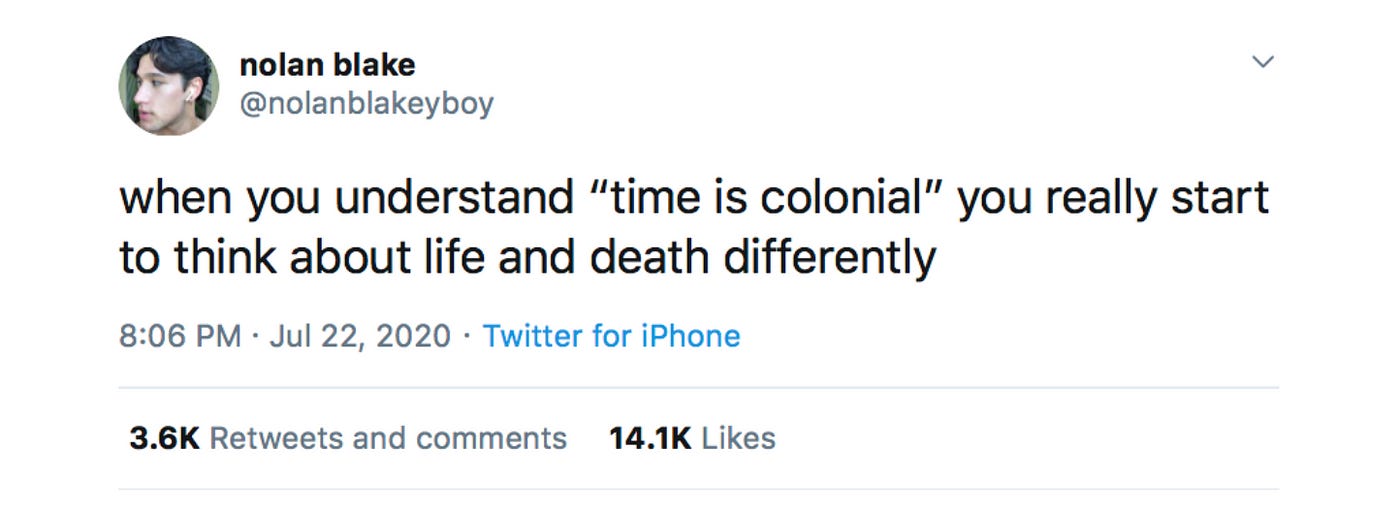
The idea that “time is colonial” is one example of punchlines with charged words that some with run with often thoughtlessly while others with challenge, often heartlessly.
So who’s right, what’s right?
Let’s explore.
Math is widely accepted as the unifying language of intelligent life and the most articulate way of understanding the natural world. An argument against math, is an argument against the natural world and an argument for distortion. To cast doubt on mathematical certainties on the premise of race, history, or culture is in defiance of intelligence.
Everyone has the right to be unintelligent in the privacy of their own mind. However, those opinions become damaging to the promise of human advancement when they’re swept into the tide of white supremacy, particularly so in a time of hyper-accelerated racial obsession.
It is little wonder why Americans are self-censoring rather than risk entering a minefield that could with the snap of some remote fingers completely devastate their lives through the abomination that is cancel culture. In that, cancel culture is little more than a collective social tantrum toward behavior beyond the approved norm of the collective social reality.
Even in some of the most otherwise capable hands, dialogue is reduced to denouncement of the political left or denouncement of the political right (one collective social reality versus another). Free speech — much like Orwell’s 1984 — is becoming correct speech. And correct speech is measured by the litmus test of one’s sociopolitical tribe. When opinion is certified as truth within respective echo chambers, God help the outlier who dare says:
Truth and reality are not the same thing.
Truth is not “your truth” or “my truth.” Truth stands outside the circle of human opinion. 2+2, for example, doesn’t care what grievance you carry against the sum of 4.
Time also stands outside the circle of human opinion.
If we were to engage in conversation that wasn’t a death match, we’d see that while time is linear it is also contextual and a construct. It is both subjective and objective. Yet, for all the things that time is, time isn’t a product of white supremacy either. Time isn’t bound to one race or cultural demographic but has in part (like math) been informed by several cultures and thinkers across generations and continents. Instead of thinking of time as a “western” or “colonial” construct, time is more like a rock skipping across the pond with each touchpoint on the water being another time and place across global civilization further shaping our understanding of this abstraction called “time.” The same can be said for math.
There is another sense of time, and that’s how time is seen in indigenous communities and through the lens of advanced sciences. Indigenous communities and their spiritual teachings have a holistic sense of time. Time is seen as a multigenerational ecosystem. It’s a beautiful framework that nurtures a deeper sense of connection between the past and the present. It’s the mindset of community, which in part lends to another accusation — that individualism is tethered to white supremacy, while failing to see that for some the past is not a compass, it is an anchor. For some, individualism offers a unique freedom to transform as pioneers of our own future.
A sense of non-linear time isn’t (in some ways) too different from the relativity of time in theoretical physics. This in nature makes the idea of heavily judging or eradicating the past even more irrational based on the ethics of subjective time. We’ll save that for another day.
My sense is that the issue of math and time being dragged over the rocks of race theory has less to do with rationality and more to do with emotion. I suspect that the heart of the grievance behind what is being labeled as ‘colonial’ is the rejection of a culture of classification of the human experience into products or units that can be commodified, calculated, or consumed. We’ll save that for another day too.
The idea of who owns truth is not a fight that yields any winners. It’s a self-destructive entanglement with no real room for the ebb and flow of conversation. We don’t have to treat a statement like “time is colonial” as fringe language that needs to be bashed over the head. But we also don’t need to accept the paradigm on offer. There is a sense that the conversation underneath the argument is a conversation of belonging. Most everything else is a symptom of that conversation gone wrong.
Circling back to language, we don’t have to accept the binary that we’re either for a thing or against it. We don’t have to accept the problematic language those broken binaries are framed in. What’s racist or anti-racist, whether we support black lives or the organization by that name, whether we need to move beyond race by deep-diving into more race — these are all different ways of saying almost exactly the same thing.
The same holds true for when we talk about American values. Which America are we talking about — America the idea or America as it moved through generational cycles? If American values are freedom, then whose freedom? Have not some been more free than others, and are some not still more free?
As an immigrant who has lived in America for over 30 years, America is pursuit of freedom and the promise of excellence to keep rising toward our higher selves, our highest human potential. What this country is will mean a lot of different things to a lot of different people. As long as that’s expressed without hate, belligerence or violence, it’s to our benefit as a civilization to understand that instead of demonize it, to work with it instead of ostracizing it.
In de-escalation strategies and the various models that challenge extremism, the rule of thumb is to understand the other instead of alienating them as “the other.” With practice, that doesn’t become a strategy, it becomes an automated behavior pattern. But it takes practice. The silver lining of the maelstrom of 2020 and beyond is that we have countless opportunities to step into authentic leadership by intentionally cultivating non-combative conversations that inspire new paradigms.
The idea that “time is colonial” or the sentiment driving irregular math, are two of many opportunities we have toward extending an invitation to conversation. But, if you’re starting a conversation with “the left” or “the right,” you’re not interested in a real conversation; you’re interested in having your narrative dominate even if it’s by force of will. And that is the tactic of an oppressor.